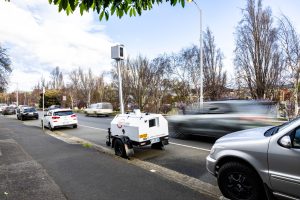
Speed

Speed is one of the top three crash factors in fatalities on Tasmanian roads. In the 10 years to 31 December 2012, exceeding the speed limit was a factor in 25 percent of fatalities and excessive speed for the conditions and/or circumstances 30 percent.

Speeding is commonly defined as driving faster than the posted speed limit but it also refers to driving faster than what is safe for the road, weather and traffic conditions.

Speeding increases the risk and severity of a crash. A recent South Australian study found that in 60 km/h zones, the risk of being involved in a crash in which someone is injured or killed approximately doubles with each 5 km/h increase in speed.

A key issue in speed-related crashes is that most motorists underestimate the distance needed to stop. The reaction distance – the distance the vehicle travels while the driver realises the need to brake – increases with speed. At 60km/h an alert driver takes about 3/4 of a second to react, in which time the vehicle travels 12 metres. The faster the vehicle is going, the longer the reaction distance.

The stopping distance is the time it takes for the a vehicle to stop from the time the brakes are applied to when the car has stopped.

A car travelling at 60 km/h in dry conditions takes about 45 metres to stop. A car travelling at 100 km/h takes about 100 metres to stop. The NSW Centre for Road Safety video below shows the difference between hitting an object at 60km/h and at 100km/h.

Speed limits establish the maximum speed limit. You don’t need to be driving over the posted speed limit to be unsafe. Adjust your speed according to the weather, road and traffic conditions to allow for unexpected hazards.

Conditions are rarely perfect and a safe driver needs to constantly alert. A three-second gap should be between your car and the vehicle in front to allow for a safe response to hazards or unexpected events. In wet conditions, this distance should increase to four seconds.

The Southern Cross Television video below shows an easy way to calculate distance between you and the car in front.

One of the Road Safety Advisory Council’s goals is to make speeding morally and socially unacceptable, much like drink driving.

A driver with a blood alcohol concentration of over 0.05 has double the normal crash risk. A driver who is travelling at 65 km/h in a 60km/h zone has exactly the same crash risk. Therefore speeding is just as dangerous as drink driving.

Police issued 43,913 speeding infringements during the 2011/12 financial year that equates to 844 people detected for speeding every week.